

VoIP GatewaySIP to E1 / T1 / PRI
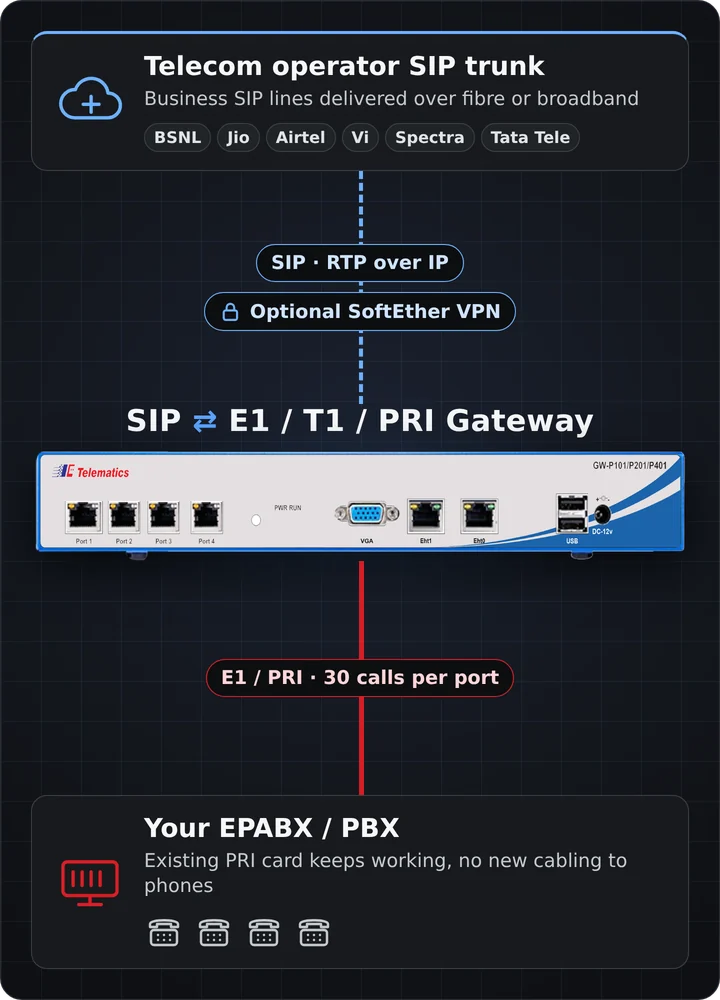
GW-P101 / P201 / P401 connect the SIP trunk from your telecom operator to the PRI card of your existing EPABX. Move to SIP lines without replacing the exchange or rewiring a single phone.
SIP Trunk to your EPABX
E1 / T1 / PRI
Move to SIP. Keep your exchange.
Operators now deliver business lines as SIP trunks over fibre. Most EPABX systems were built for PRI. The gateway sits between the two, so the exchange, the extensions and the users carry on as before.
Your EPABX investment
Connects to the PRI card the exchange already has. No new PBX, no rewiring to desks.
Works with major operators
Compatible with SIP trunks from BSNL, Jio, Airtel, Vi, Spectra and Tata Tele Business Services.
Failover and auto reboot
Trunk priority, failover routing and automatic reboot keep calls flowing.
Web GUI, SSH and CLI
Set up from a browser. Engineers can also use SSH and the Asterisk command line.
How it works
The gateway registers your SIP accounts with the operator on one side and appears to the EPABX as ordinary E1 / PRI lines on the other. Calls convert in both directions.
Connect to the network
Plug the LAN port into the router or fibre ONU that carries the operator's SIP trunk, and register the SIP accounts.
Connect the EPABX
Cable the E1/T1/J1 port of the gateway to the PRI card of the exchange. Each port carries up to 30 calls.
Set the routing
Map numbers, dial plans and trunk groups. Incoming SIP calls ring on the EPABX; outgoing calls leave on SIP.
GW-P101 also has SoftEther VPN built in, so the SIP trunk can travel through an encrypted tunnel to the operator or a central server.
Choose by the number of calls
One E1 / PRI port carries 30 calls at once. Pick the model that matches how many simultaneous calls your site needs.

GW-P101
1 × E1/T1 · 30 calls
Compact single-port gateway for one PRI line. Two 10/100 Mbps Ethernet ports, 3 W power draw and inbuilt SoftEther VPN.
Enquire about GW-P101
GW-P201
2 × E1/T1 · 60 calls
Two PRI ports for larger exchanges or two separate PBXs. Gigabit Ethernet, two USB 2.0 ports and VGA.
Enquire about GW-P201GW-P401
4 × E1/T1 · 120 calls
Four PRI ports in the same chassis as GW-P201, for hotels, hospitals and call centres with heavy call traffic.
Enquire about GW-P401Technical specifications
All three models share the same software: SIP, routing, management and network features are identical.
| Specification | GW-P101 | GW-P201 | GW-P401 |
|---|---|---|---|
| Telephony | |||
| E1 / T1 ports | 1 | 2 | 4 |
| Concurrent calls | 30 | 60 | 120 |
| Signalling | PRI / R2 / SS7 | PRI / R2 / SS7 | PRI / R2 / SS7 |
| Codecs | G.711A, G.711U, G.729A, G.723.1, G.722, GSM | ||
| Fax | T.38 and pass-through | ||
| SoftEther VPN | Inbuilt | ||
| Interfaces | |||
| Ethernet | 2 × 10/100 Mbps | 2 × 10/100/1000 Mbps | 2 × 10/100/1000 Mbps |
| USB | – | 2 × USB 2.0 | 2 × USB 2.0 |
| VGA | – | 1 | 1 |
| Physical | |||
| Power supply | 12 V / 2 A | 12 V / 2 A | 12 V / 2 A |
| Power consumption | 3 W | 18 W | 18 W |
| Dimensions (W × D × H) | 232 × 152 × 45 mm | 310 × 162.5 × 44 mm | 310 × 162.5 × 44 mm |
| Weight | 1.2 kg | 1.35 kg | 1.35 kg |
| Operating temperature | 0 to 50 °C | 0 to 70 °C | 0 to 70 °C |
| Operating humidity | 10–90 % non-condensing | 5–95 % non-condensing | 5–95 % non-condensing |
| Storage temperature | −20 to 70 °C | −40 to 85 °C | −40 to 85 °C |
Scroll the table sideways on a phone to see all three models.
A closer look
Front-panel status lights for power, run and each E1 line; all connections on one panel.

Features
Common to GW-P101, GW-P201 and GW-P401.
SIP features
- Add, modify and delete SIP accounts
- SIP registration with domain
- Multiple SIP registrations
- SIP accounts registered to multiple servers
- Combine different SIP trunks into a group
- SIP (RFC 3261) compliant
- DTMF: RFC 2833, SIP INFO, in-band
- T.38 and pass-through fax
Routing
- Flexible routing settings
- Up to 512 routes
- Caller and callee number manipulation and filtering
- Trunk groups with trunk priority management
- Add, modify and delete routes
- E1 / T1 port grouping
- Failover
System and management
- Configuration through web GUI
- Protocols: SIP, IAX, TCP, UDP, RTP, SSH, HTTP, HTTPS
- NTP and client time synchronisation
- SSH access and Asterisk CLI commands
- Port group management
- Custom dial plans
- Firmware update over HTTP
- Call statistics
- Auto provisioning
- Live channel status
- Backup and upload of configuration file
- Detailed log output
- Automatic reboot
Network
- Static IP and DHCP
- IPv4, UDP / TCP, DHCP, TFTP, SCP
- HTTP / HTTPS / SSH
- DDNS
- Ping and trace route from the web interface
- Network packet capture from the web interface
Compatible with leading operators
The gateway works with SIP trunks from India's major telecom and enterprise service providers.
Tell us which operator supplies your SIP trunk and we will confirm the settings before installation.
- BSNL
- Jio
- Airtel
- Vi
- Spectra
- Tata Tele Business Services
Where the gateway is used
Any site with a PRI-capable exchange that wants to move to SIP trunks.
PRI to SIP migration
Replace physical PRI lines with a SIP trunk while the EPABX stays in place.
Hotels and hospitals
Large exchanges with many extensions keep their features, room and ward numbering.
Call centres
Up to 120 simultaneous calls on GW-P401, with trunk groups and failover.
Fax over IP
T.38 and pass-through keep fax machines working on the SIP trunk.
Building the whole link?
Add the pocket-sized TX-101 SoftEther VPN router to carry the SIP trunk through an encrypted tunnel, or pair the gateway with the TCX200 modular PBX. Ask us which combination suits your site.
Download the brochures
Features and technical specifications (PDF).
Enquire about the VoIP gateway
Tell us your EPABX make and model, your SIP trunk operator and how many calls you need at the same time. We will come back with the right model, a price and an installation plan.